
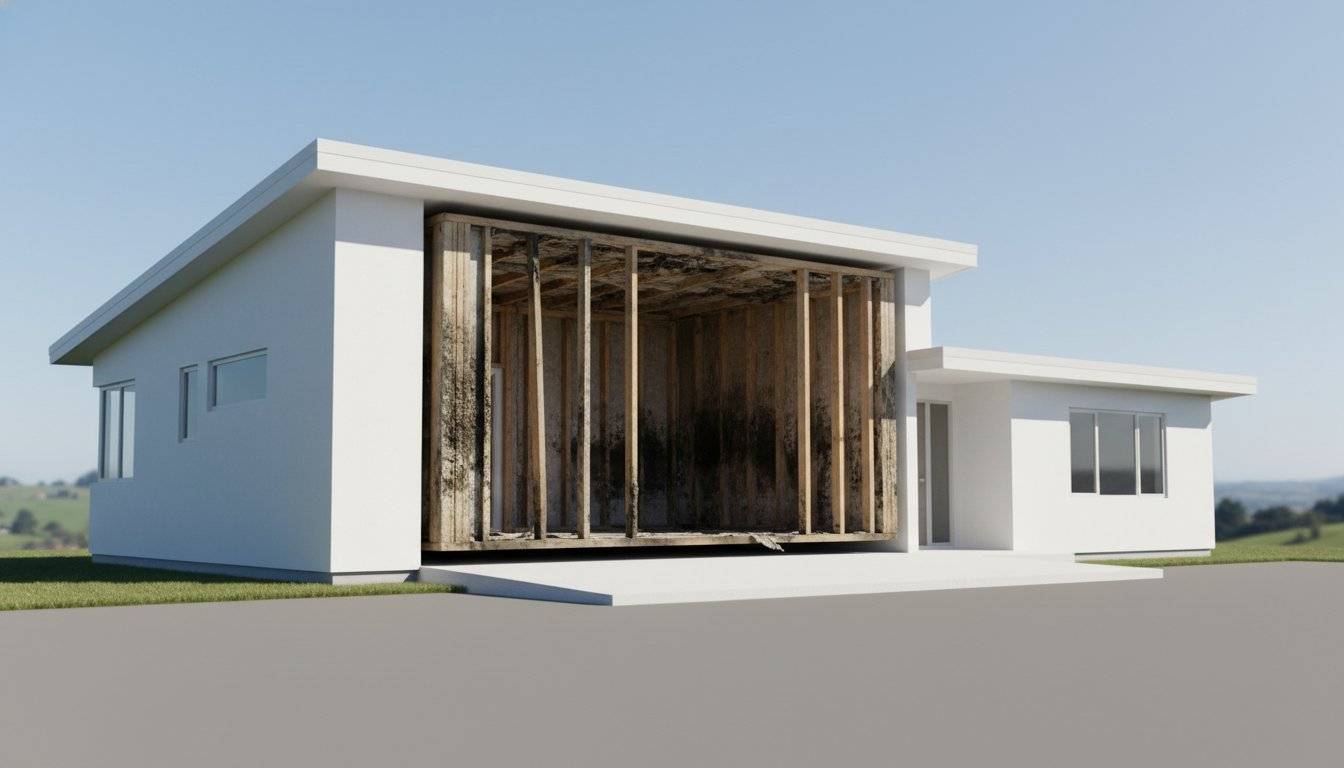
One bad investment can turn your property empire into a financial black hole. A single undetected leak can trigger a catastrophic chain reaction, costing you hundreds of thousands in repairs and derailing your entire wealth strategy. For any serious Property CEO, the crisis of leaky homes NZ represents one of the single greatest threats to your capital. It’s a silent portfolio killer, turning dream investments into financial nightmares while posing serious health risks from mould and damp.
Stop guessing and take control. This guide gives you the proven framework to confidently identify the critical red flags, understand the non-negotiable due diligence steps, and avoid making a multi-million dollar mistake. It’s time to protect your portfolio and invest with absolute certainty, ensuring every acquisition moves you closer to financial freedom, not financial disaster.
The Leaky Homes Crisis: Your CEO Briefing on This Critical Market Risk
As a Property CEO, your primary job is to manage risk and seize opportunity. The problem of leaky homes nz isn’t just a piece of history; it’s an active financial minefield that can destroy your portfolio. In simple terms, this crisis refers to a period when thousands of homes were built with systemic weathertightness failures, leading to rot, mould, and structural decay. This wasn’t a minor issue-it was a systemic failure of design, materials, and regulations that created a multi-billion dollar problem. For a detailed historical context, the Leaky homes crisis overview provides a comprehensive breakdown.
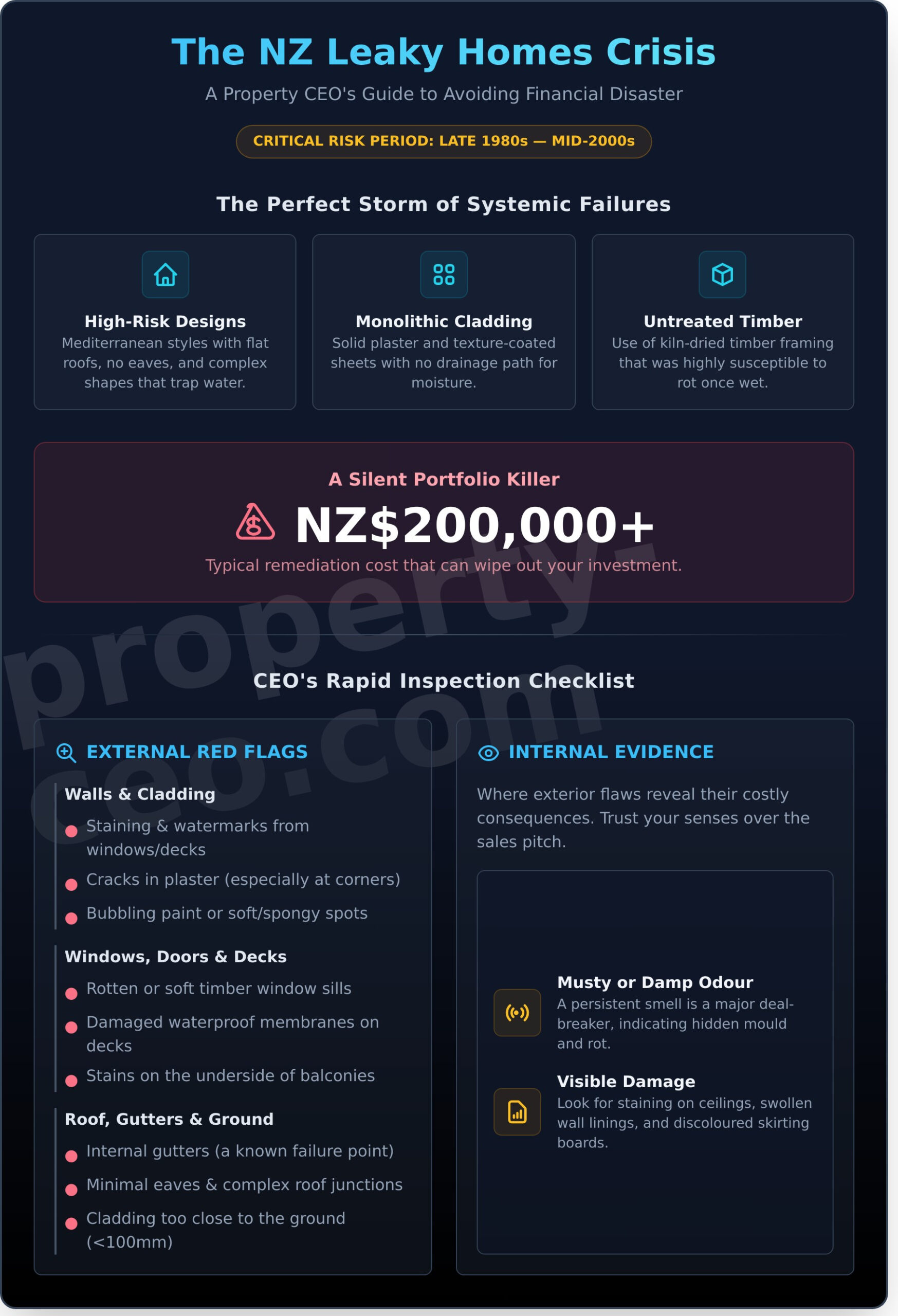
This perfect storm occurred primarily from the late 1980s to the mid-2000s. A rush for Mediterranean-style homes, the approval of new monolithic cladding systems, and a shift to using untreated timber framing created properties that were fundamentally unable to handle New Zealand’s weather. This isn’t about fear; it’s about market intelligence. Knowing the risk is the first step to leveraging it.
High-Risk Building Characteristics
You don’t need to be a builder to spot the red flags. As a CEO, you need a high-level playbook. These are the critical warning signs that a property falls into the high-risk category:
- Monolithic Cladding: Think solid plaster, stucco, or texture-coated fibre cement sheets that leave no room for drainage.
- High-Risk Design: Flat roofs, minimal or no eaves, and complex architectural shapes that trap water instead of shedding it.
- Built-in Failure Points: Decks or balconies built directly over living areas and poorly designed internal gutters are classic problem areas.
- Untreated Timber Framing: The use of kiln-dried, untreated timber during this era meant any moisture that got in would lead directly to rot.
Why This Still Matters for Today’s Investor
Thinking this is old news is a mistake that could cost you everything. These properties are still actively traded, often with patched-up repairs that hide the underlying rot. A ‘bargain’ can quickly become a financial black hole, with remediation costs easily exceeding NZ$200,000 and wiping out your entire investment. But here’s the upside: understanding this risk gives you a powerful competitive advantage. While other investors operate on hope, you operate on strategy. You can identify and avoid these portfolio-killers, protecting your capital and positioning yourself to acquire sound assets with confidence.
The Property CEO’s External Inspection Checklist
Before you spend a single dollar on professional reports, you must conduct your own strategic reconnaissance. This isn’t a casual stroll; it’s a systematic external audit designed to spot the red flags that amateurs miss. Think of it as your first line of defence against a multi-six-figure mistake. Your mission is to identify potential water ingress issues early, allowing you to walk away from a deal before it drains your capital and your time. Document every potential issue with photos. This initial due diligence is a critical step in the playbook for identifying leaky buildings and protecting your portfolio.
Walls & Cladding System
The building’s skin is its primary shield. Any weakness here is a major liability. Arm yourself with a critical eye and scan the entire exterior for these tell-tale signs of failure:
- Staining & Watermarks: Look for dark, discoloured patches or vertical streaks, especially running down from windows or deck junctions.
- Cracking: Pay close attention to hairline or larger cracks in plaster cladding, particularly around the corners of windows and doors where stress is highest.
- Paint & Plaster Defects: Check for any bubbling, blistering, or peeling paint. Gently press on the cladding in suspect areas-soft or spongy spots are a serious warning sign.
- Patchy Repairs: Note any areas where repairs have been made with poorly matched paint or plaster. This often indicates a recurring problem has been covered up, not solved.
Windows, Doors & Decks
These are the most common failure points in the building envelope. Water will exploit any gap, so your inspection must be meticulous.
- Window Sills & Frames: Examine timber sills for any swelling, softness, or rot. Check the seals and flashings (the metal strips designed to channel water away) for gaps, cracks, or signs of deterioration.
- Decks & Balconies: For cantilevered decks, check the waterproof membrane for damage or lifting. Ensure there is adequate drainage and a clear slope away from the building.
- Underside Stains: Always look underneath decks and balconies. Water stains, rot, or peeling paint on the soffits (the underside) are direct evidence of a leak from above.
Roof, Gutters & Ground Level
Gravity is not your friend when design or maintenance is poor. Issues at the top and bottom of a property are often the root cause of the most severe problems with leaky homes nz.
- Gutters & Downpipes: Internal gutters are a known high-risk feature. Look for overflow staining on the cladding below them. Ensure all gutters are clear of debris and are directing water effectively.
- Roof Design: Be wary of overly complex roof designs with multiple junctions, minimal eaves, or flat membrane areas that meet vertical walls. Simpler is almost always safer.
- Ground Clearance: The bottom edge of the cladding must have sufficient clearance from the ground or paving (typically 100mm-150mm). If it’s too low, it will wick up moisture.
Interior Investigation: Uncovering Hidden Water Damage
Your exterior inspection raised red flags. Now it’s time to move inside, where the true financial consequences of a leaky building become undeniable. This isn’t just about aesthetics; it’s about uncovering the hidden rot that can destroy your profit margins. Forget what the agent tells you. Trust your senses. If you smell a persistent musty or damp odour, you’re likely smelling a deal-breaker. This is the crucial stage where you connect the exterior clues-like cracked cladding or missing flashings-with the internal damage they’ve caused.
Ceilings, Walls & Floors
Water travels downwards, and the evidence it leaves is your roadmap to a property’s health. A Property CEO doesn’t just glance; they execute a systematic scan. Start high and work your way down.
- Scan Ceilings: Look for yellow or brown water stains, small black mould spots, or any visible sagging in the ceiling lining. This is a direct sign of a roof or upper-level leak.
- Check Walls: Look for peeling paint or bubbling wallpaper, particularly around window and door frames. Press gently on Gib board walls-especially below windows-to feel for any softness, sponginess, or swelling.
- Inspect Floors: Examine skirting boards for warping or dark stains. Look for signs of flooring lifting or cupping, which indicates moisture is coming up from below or down from the walls.
This systematic approach is non-negotiable for identifying the tell-tale signs of leaky homes nz. Your due diligence process should be a repeatable playbook, not a guessing game. To add a layer of official guidance to your inspection, the government’s official guide to identifying leaky buildings offers a comprehensive checklist that every serious investor should have in their toolkit.
Windows & Wet Areas
Certain areas in a home are notorious failure points. Pay forensic attention to these high-risk zones where water ingress is most common and can lead to tens of thousands of dollars in repairs.
- Windows: Check for condensation trapped between the panes of double-glazed windows, a sign the seal has failed. Examine internal timber sills for any swelling, rot, or paint damage.
- Kitchens & Bathrooms: Look for swollen or discoloured cabinetry under sinks. Check that silicone seals around showers, baths, and vanities are intact-not cracked, mouldy, or pulling away from the wall. A failed seal is a direct entry point for water into your wall framing.
Your Due Diligence System: Moving Beyond a Visual Check
An amateur investor walks through a property and relies on gut feel. A Property CEO operates from a playbook, relying on hard data to make profitable decisions. When it comes to the high-stakes issue of weathertightness, a visual check is not just insufficient-it’s reckless. Your due diligence is a non-negotiable system designed to eliminate catastrophic risk.
Remember, spending a few thousand dollars on expert reports is an investment, not an expense. It’s the cheapest insurance policy you can buy against a multi-million dollar mistake. This is where you leverage professionals to de-risk your purchase decisively and move forward with absolute confidence.
Engaging a Building Surveyor
Your first move is to engage a qualified, independent building surveyor-ideally a member of the New Zealand Institute of Building Surveyors (NZIBS). Don’t just ask for a standard building report; you need a comprehensive weathertightness report. This is your primary defence against the hidden financial traps of leaky homes nz. Ensure the report includes:
- A thorough visual inspection of high-risk areas.
- Non-invasive moisture meter readings around all windows, doors, and junctions.
- A clear summary of risks and recommendations.
If major red flags are raised, ask the surveyor about the cost and process for invasive testing for conclusive evidence.
Analysing the LIM Report
Simultaneously, you must order a Land Information Memorandum (LIM) report from the local council. This document is a historical record of the property from the council’s perspective. You are looking for any official paper trail related to weathertightness issues, consents, or unconsented work. Scrutinise it for:
- Notices or orders related to the Building Act.
- Original building plans that show high-risk features like monolithic cladding or untreated timber framing.
- Records of any additions or alterations to cross-reference with what you see on-site.
The Final Verdict: Making an Informed Decision
Now, you combine your own inspection with the hard data from the professionals. If the building report and LIM are clean, you have the confidence to proceed. If issues are found, your job is to quantify the financial risk. An NZ$80,000 repair bill on a high-equity deal might be a calculated risk, but a potential NZ$400,000 remediation makes it a clear ‘no’. This systematic approach removes emotion and protects your capital.
This is how you build a resilient, high-growth portfolio. Need a strategy to navigate these risks? Book a call.
The Financial Fallout: The True Cost of a Leaky Home
This isn’t just a maintenance issue; it’s a financial catastrophe waiting to detonate inside your investment portfolio. For a Property CEO, a leaky home is more than a building flaw-it’s a direct threat to your equity, your cashflow, and your journey to financial freedom. The “cost” extends far beyond a simple repair bill, creating a domino effect that can cripple your assets for years.
Stop thinking about patching a leak. Start understanding the full-scale financial assault you’re facing.
Remediation Costs & Process
Forget minor repairs. Fixing a systemically leaky building almost always requires a full, invasive re-clad. This isn’t a quick fix; it’s a major construction project designed to strip the building back to its bones and rebuild it correctly. The price tag reflects the complexity.
- Full Re-clad Costs: Expect to invest anywhere from NZ$200,000 to NZ$500,000+ for a standard-sized home. This involves removing all exterior cladding and replacing rotten timber framing.
- Associated Expenses: Factor in tens of thousands more for scaffolding, council consents, architectural plans, and project management.
- Disruption Costs: You will likely need to fund alternative accommodation for months, adding another significant layer of expense and stress.
Impact on Value, Insurance & Lending
The financial damage doesn’t stop once the repairs are done. The stigma associated with leaky homes nz leaves a permanent scar on the property’s value. Even with a new Code of Compliance Certificate, the property’s history will deter buyers and force you to sell at a significant discount.
Worse, the asset becomes toxic to lenders and insurers.
- Insurability: Most insurance policies explicitly exclude gradual water damage, leaving you to foot the entire remediation bill yourself.
- Bank Lending: Banks are extremely cautious. They may refuse to lend against a known leaky building or demand a much larger deposit, trapping your equity and limiting your ability to leverage.
For a Property CEO, this is the ultimate liability. It’s a non-performing asset that drains capital, blocks growth, and actively works against your wealth-building strategy. Add the potential for significant health costs from toxic mould exposure, and you have a perfect storm of financial and personal disaster. Protecting your portfolio starts with identifying and eliminating these threats before they take hold. Your mission is to build a robust financial future, and that requires a rock-solid foundation for your investments.
Don’t Let a Leaky Home Sink Your Property Empire
The lesson is clear: a surface-level glance won’t protect you from a six-figure disaster. As a Property CEO, your greatest asset is a system for identifying risk. Understanding the external red flags, the subtle interior signs, and the true financial cost of leaky homes nz is non-negotiable. This isn’t just about avoiding a bad deal; it’s about protecting your capital so you can build your portfolio with confidence.
Guesswork is for amateurs. Strategy is for CEOs. If you’re ready to move beyond theory, it’s time to get guidance from people who have done real deals. Join a community of over 250+ successful Kiwi investors who are actively building wealth. Our members have completed over $100M in property deals using our proven frameworks.
Stop guessing. Get the proven framework to invest safely. Request a Free Strategy Call. Your next move will define your success-make it a calculated one.
Frequently Asked Questions
Is all monolithic cladding bad?
No, but it’s a non-negotiable red flag that demands expert investigation. The real enemy isn’t the cladding itself, but the system it was installed with. Monolithic systems from the 1990s and early 2000s were often fixed directly to the framing, leaving no room for moisture to escape. Modern systems with a drained cavity are far superior. As a Property CEO, your job is to identify the system, assess the risk, and act accordingly. Don’t guess, get an expert opinion.
How much does a professional weathertightness report cost in NZ?
Expect to invest between NZ$600 and NZ$2,000+ for a comprehensive weathertightness report in New Zealand. The price varies based on the size of the property and the level of invasive testing required. Don’t view this as a cost; view it as a critical investment in risk mitigation. Spending a thousand dollars now could save you a NZ$250,000 remediation bill later. This is a non-negotiable line item in your due diligence budget for any potential deal.
Can you get a mortgage on a property with a history of leaks?
It’s challenging, but not impossible for a savvy investor. Mainstream banks see these properties as high-risk, so expect to need a much larger deposit-often 40% or more. You’ll also need a bulletproof plan, including a full remediation scope and fixed-price quotes from reputable builders. Securing finance requires you to present the bank with a de-risked solution, not just a problem. This is an advanced strategy that demands absolute clarity and control.
What legal options do I have if I buy a leaky home?
Your options are time-sensitive and complex, so you must act with urgency. The primary avenue is a claim under the Building Act, which has a strict 10-year “long stop” limitation period from the date the work was done. You may have a claim against the council, builder, or developer. Stop guessing and get professional legal advice immediately. A Property CEO builds a team of experts to execute strategy-this is when you deploy your legal counsel.
Are new builds exempt from leaky building syndrome?
No. While building code changes have significantly reduced the risk, new builds are not immune to weathertightness issues. Poor workmanship, design flaws, or incorrect product installation can still lead to catastrophic failures. The systemic issues that created the initial crisis of leaky homes nz have been addressed, but individual failures still occur. A smart investor never assumes compliance; they verify it with their own independent building inspection before committing to a purchase.
Does a recent renovation guarantee a house is not leaky?
Absolutely not. In fact, a cosmetic renovation can be a deliberate tactic to conceal water damage, rot, and mould. Fresh paint and a new kitchen mean nothing if the structure behind the walls is failing. As a Property CEO, you must look past the superficial appeal and demand evidence. Ask for the Code of Compliance Certificate (CCC) for any recladding work. No paperwork means no proof, and for your portfolio, that means unacceptable risk.