

With every headline about the rising cost of living, the official minimum wage NZ rate can feel less like a safety net and more like a hard ceiling. You work hard, you trade your valuable hours for dollars, but the goal of real financial freedom seems to drift further away. Are you tired of just getting by? Of feeling like your income potential is capped while your expenses are not?
This guide provides the essential 2026 numbers you need to know. But more importantly, it delivers a blueprint to make that wage irrelevant to your future. We will show you the proven framework everyday Kiwis are using to stop trading time for money and start building lasting wealth through property. Forget the myth that property investment is out of reach-it’s time to learn how to build your own portfolio, generate income on your terms, and become the CEO of your financial destiny.
What is the Minimum Wage in NZ for 2026?
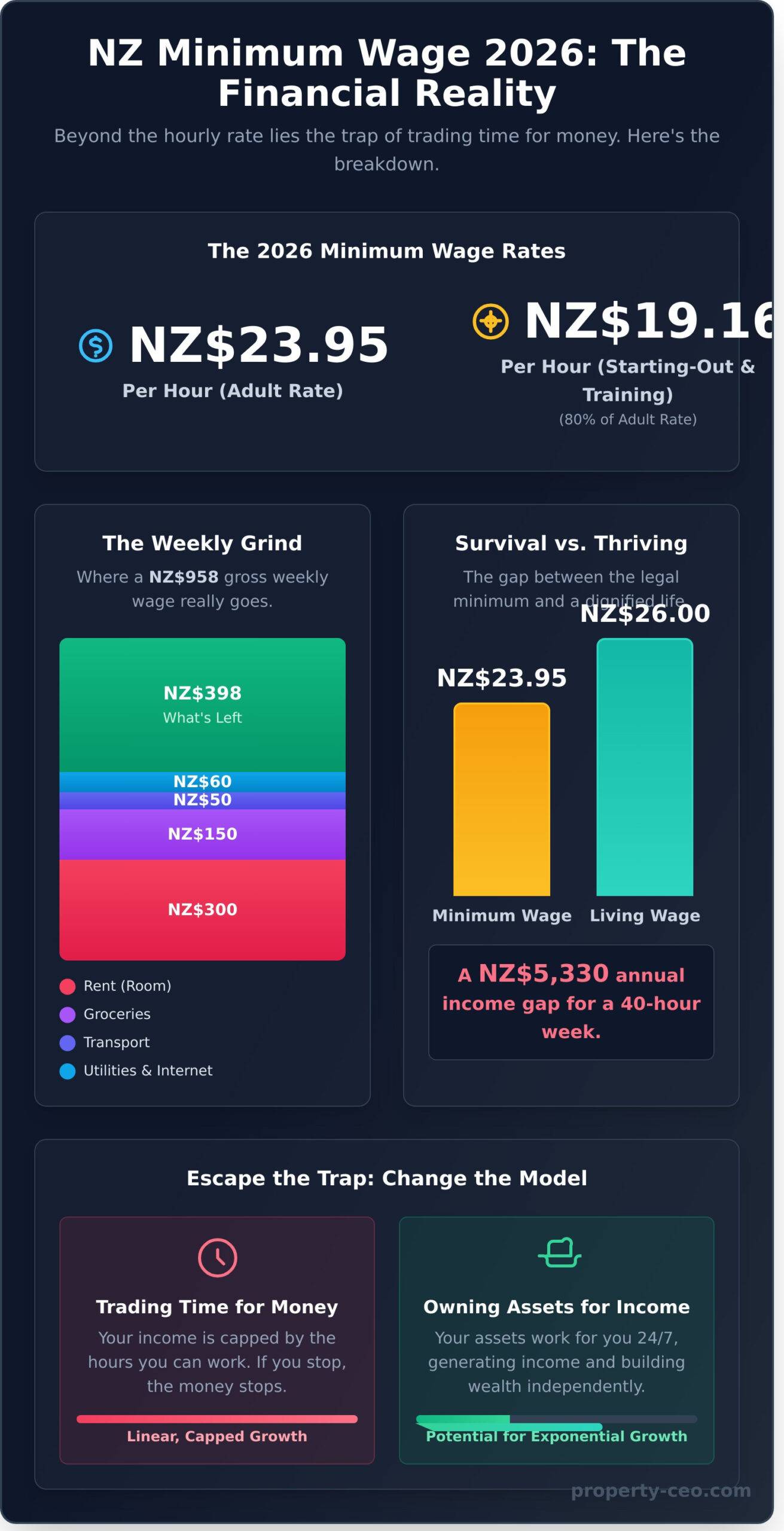
Effective from 1 April 2026, the adult minimum wage in New Zealand is NZ$23.95 per hour before tax. This figure is the absolute baseline-the legal minimum an employer can pay an eligible employee. For anyone serious about achieving financial freedom, this number isn’t a target; it’s the starting block you must accelerate away from.
The New Zealand Government reviews these rates annually to account for inflation and economic conditions, a practice that reflects the global history of minimum wage as a tool for social and economic policy. As a future Property CEO, understanding the official minimum wage nz provides a critical data point for calculating rental yields, assessing market affordability, and building your wealth creation strategy.
Here is a breakdown of the adult minimum wage earnings before tax:
.wage-table { width: 100%; border-collapse: collapse; margin: 20px 0; font-size: 1em; }
.wage-table th, .wage-table td { border: 1px solid #dddddd; text-align: left; padding: 12px; }
.wage-table th { background-color: #f2f2f2; font-weight: bold; }
| Rate Type | Pre-tax Earnings (NZD) |
|---|---|
| Hourly Rate | NZ$23.95 |
| Daily Rate (based on an 8-hour day) | NZ$191.60 |
| Weekly Rate (based on a 40-hour week) | NZ$958.00 |
These figures, set and published by government bodies like MBIE and Employment New Zealand, apply to most of the workforce. However, there are two other specific rate categories to be aware of.
Adult Minimum Wage
The Adult Minimum Wage of NZ$23.95 per hour applies to all employees aged 16 and over who are not starting-out workers or trainees. This is the standard rate that most Kiwis refer to when discussing their wages. If you are building a financial plan, this is the foundational income level your strategy must be designed to significantly outperform through assets and cashflow, not just trading time for money.
Starting-Out and Training Minimum Wage
Set at 80% of the adult rate, the Starting-Out and Training minimum wage is NZ$19.16 per hour. This is not a youth wage; it applies only under specific conditions to encourage employers to hire and train new workers.
- Starting-out workers are typically 16-17 year olds in their first six months of continuous employment with a single employer.
- Training workers are employees aged 20 or over who are completing a recognised industry training course that requires at least 60 credits a year.
These rates are exceptions, not the rule. For most working adults, the full adult rate is the legal requirement.
The Reality: Can You Live on the Minimum Wage in NZ?
The government sets a minimum wage, but does that number translate to a life of freedom? Or does it simply lock you into a cycle of trading time for money with zero room to move? Let’s break down the numbers and expose the truth.
For most Kiwis, the official minimum wage nz is a financial trap, not a foundation for wealth. It’s designed for survival, not for building the life you want.
Annual Income vs. Average Expenses
Working a 40-hour week on the current minimum wage of NZ$23.15 an hour gives you a gross annual income of NZ$48,152. After tax, you’re looking at roughly NZ$785 in your hand each week. Now, let’s see how quickly that vanishes in a city like Auckland, even on a tight budget:
- Rent (a room in a flat): NZ$300
- Groceries: NZ$150
- Transport: NZ$50
- Utilities & Internet: NZ$60
That’s NZ$560 gone before you’ve paid for your phone, clothes, insurance, or a single coffee. You’re left with a small buffer that gets wiped out by one unexpected car repair or dental bill. Saving? Investing? Building a property portfolio? It’s simply not possible. This is the reality of the grind.
Minimum Wage vs. The Living Wage
This is where the gap between surviving and thriving becomes crystal clear. The Living Wage is an alternative measure, set independently to reflect what a worker actually needs to live with dignity. It’s not about luxury; it’s about covering core costs and participating in society.
The current Living Wage is NZ$26.00 per hour. That’s nearly NZ$6,000 more per year than the legal minimum. This isn’t a random number; the official Living Wage calculation is based on detailed research into the real costs of living in Aotearoa. Earning the legal minimum wage nz means you are fundamentally starting from behind. It’s a clear signal that the system isn’t designed for you to get ahead-it’s up to you to build your own system.
The Real Problem: Escaping the ‘Trading Time for Money’ Trap
Let’s be direct. The conversation around the minimum wage nz often misses the real point. The problem isn’t just the dollar amount per hour; it’s the entire model of exchanging your limited time for a fixed income. Whether you earn $23.15 an hour or $200,000 a year, you are still stuck in the same trap: trading time for money.
If you stop working, the money stops. This is not a path to freedom. It’s a treadmill.
True financial independence comes from owning assets that work for you, generating income 24/7, long after you’ve clocked out.
Why Your Salary Will Never Make You Wealthy
A traditional job, by its very design, puts a ceiling on your earning potential. Your employer dictates your value, and you can only work so many hours in a week. This fundamental limit is why a salary is a tool for survival, not for building wealth.
- The Income Ceiling: You can only earn as much as your role allows. Promotions are slow and raises rarely outpace the true cost of living.
- Erosion of Value: Inflation and taxes constantly chip away at your paycheque, meaning you’re working harder just to stand still.
- No Leverage: You have 24 hours in a day. You can’t scale yourself. You can’t be in two places at once.
This is the core problem we solve at Property-CEO. We give you the playbook to break through that ceiling and build a system that works for you.
The Mindset Shift: From Employee to ‘Property CEO’
The first step is a radical mindset shift. You must stop thinking like an employee and start acting like the CEO of your own financial future-a ‘Property CEO’. The employee mindset prioritises security from a single source (your job). The investor mindset, the CEO mindset, prioritises growth, leverage, and control.
It’s about building a portfolio of assets that generates cashflow, independent of your time. This is how you take back control from your employer and build a life on your own terms.
Ready to stop trading time for money? See how it works.
The Alternative: How Property Generates Income While You Sleep
If your income is directly tied to the hours you work, you are caught in a trap. You can only earn as much as you have time for. Property investing shatters this model. It’s not another job; it’s the creation of an asset-a business that works for you around the clock, generating income long after you’ve clocked out.
Wealth from property is built in two powerful ways: immediate cash injections and long-term passive income. This is how you stop trading time for money and start building real financial independence.
Cash on Demand: Profit from a Single Property Flip
Imagine replacing your entire annual salary with one smart transaction. This is the power of a property flip. The strategy is simple: find an undervalued property, execute a strategic renovation to add massive value, and sell it for a significant profit. For example:
- Purchase Price: NZ$550,000
- Renovation Cost: NZ$40,000
- New Sale Price: NZ$680,000
That’s a potential gross profit of NZ$90,000. A single, well-executed project could generate more capital than working two full years on the current minimum wage nz. This isn’t just income; it’s a strategic cash injection to fund your next investment or your lifestyle.
Long-Term Wealth: Cashflow from Rental Properties
While flips provide capital, rentals build your empire. A well-chosen rental property generates monthly income that covers the mortgage, rates, and other costs. The money left over is pure cashflow-passive income that lands in your bank account without you trading any more time.
Best of all, your tenants are paying down your mortgage, building your equity for you month after month. As the loan shrinks, your cashflow grows. This is combined with long-term capital growth, where the value of your asset increases over time, creating life-changing wealth while you sleep.
This is how you truly become the CEO of your financial future. You build a portfolio of assets that work for you, not the other way around. Ready to see the blueprint? Learn more about the systems we use at property-ceo.com.
Your First Step: How Everyday Kiwis Can Start Investing
The single biggest objection we hear is, “I don’t have enough money to start.” This is a myth. Building a property portfolio isn’t about saving for 20 years. It’s about having a proven system. Financial freedom isn’t reserved for the elite; we’ve seen Kiwis on modest incomes build significant wealth because they focused on strategy, not just savings. The right knowledge gives you leverage that a salary, even one well above the minimum wage nz, never will.
Stop thinking like an employee and start acting like a CEO of your own future. Here’s how you begin.
Finding the Right Deals (That Others Miss)
Seasoned investors know a universal truth: profit is made when you buy, not when you sell. The key is to stop scrolling through Trade Me and start hunting for what others can’t see. We teach our members a systematic process to find undervalued, off-market properties with built-in equity from day one. This isn’t about luck; it’s a learnable skill that creates opportunities on demand.
Funding Your Deals Creatively
Think a 20% cash deposit is the only way into the New Zealand property market? Think again. That belief keeps most people trapped. Successful Property CEOs use sophisticated strategies to get deals done with little of their own money down. This includes:
- Leveraging equity from your existing home.
- Structuring joint venture (JV) partnerships.
- Using other creative financing options the banks don’t advertise.
These are the exact methods you learn with an experienced coach who can guide you through the process safely.
Building Your Team and Getting Guidance
No one builds a property empire alone. Trying to do so is a recipe for expensive, soul-crushing mistakes. The fastest path to success is to surround yourself with a team of experts-a mentor, a broker, a lawyer, and a community of fellow investors who hold you accountable. A coach doesn’t just give you a map; they help you navigate it, avoiding the pitfalls that derail 99% of aspiring investors.
Your journey from trading time for money to creating real wealth is possible, but it requires a plan. It’s time to stop guessing and get a roadmap built for you.
Ready to take control? Request a Free Strategy Call to build your personal roadmap.
Your Next Step Beyond the Minimum Wage
The numbers are clear: relying on the minimum wage nz is a strategy for survival, not for freedom. We’ve seen how it keeps you locked in the ‘trading time for money’ cycle, where your income is always capped by the hours in your day. The only way to truly get ahead is to build assets that generate income for you-and property is the proven vehicle for everyday Kiwis to do just that.
Stop waiting for a pay rise to change your life. It’s time to take control. Join our community of over 250+ Kiwi investors who are using our step-by-step system-designed for busy professionals-to build real wealth. With over $100M in property deals completed, our members have the results to prove this works.
Your life as a Property CEO starts with a single, decisive step. Book a Free Strategy Call today and let’s build your financial freedom plan together. The future you want is waiting for your command.
Frequently Asked Questions
What is the difference between the minimum wage and the living wage in NZ?
The minimum wage is the legally mandated hourly rate set by the government that employers must pay. It’s the absolute floor. The living wage is an independently calculated rate that reflects what a worker needs to earn to live with dignity and participate as an active citizen. Think of the minimum wage as the starting line for survival, while your goal as a Property CEO is to build an income stream that makes both benchmarks irrelevant to your financial freedom.
Can you buy a house in NZ on a minimum wage income?
Securing a mortgage for a median-priced home on a single minimum wage income is extremely challenging due to bank serviceability tests. This is where strategy becomes more important than your hourly rate. Tactics like partnering with others, exploring rent-to-own options, or targeting high-yield properties in more affordable regions can create a path forward. The obstacle isn’t your wage; it’s the lack of a proven financial playbook to get you on the property ladder.
How much income do you need to start investing in property in New Zealand?
Banks focus less on a specific income number and more on your deposit size and your ability to service the mortgage. Typically, you need a 20% deposit, which means $120,000 for a $600,000 property. The key isn’t waiting for a massive salary increase but implementing a system to build your deposit through savvy savings, leveraging existing assets, or joint venture partnerships. Your income simply needs to be stable enough to prove you can handle the repayments.
Are the minimum wage rates before or after tax?
All official minimum wage rates in New Zealand are quoted as the gross amount, which is before any tax is deducted. Your actual take-home pay (your net income) will be lower after PAYE, ACC levies, and any other contributions like KiwiSaver are taken out. Understanding the critical difference between gross revenue and net cashflow is a foundational skill for managing your personal finances and your future property portfolio like a CEO.
Does the minimum wage apply to casual and part-time workers?
Yes, absolutely. The minimum wage is the legal floor for nearly all employees in New Zealand aged 16 and over, regardless of whether they work full-time, part-time, or on a casual basis. Every hour worked must be paid at or above the current rate. There are very few exceptions, such as for some trainees or those on a starting-out wage, but for the vast majority of roles, the minimum entitlement is non-negotiable.
How often does the NZ minimum wage increase?
The government reviews the minimum wage nz rates every year. Any adjustments are typically announced early in the year and take effect on April 1st. While these incremental increases provide some relief, relying on them for your financial future is the definition of trading time for money. The objective is to build a system that generates cashflow far beyond this government-set floor, giving you true control and financial independence.