
You’ve read the books. You’ve listened to the podcasts. You’ve scrolled through countless success stories online, dreaming of the day you’ll finally buy your first investment property. But a voice in your head keeps you stuck in ‘analysis paralysis’-the fear of making a colossal, expensive mistake. What if I told you that you could learn the most critical lessons without risking your own capital? I’m sharing the five brutal, real-world lessons from my first property flip so you can save the time, money, and stress I wish I had.
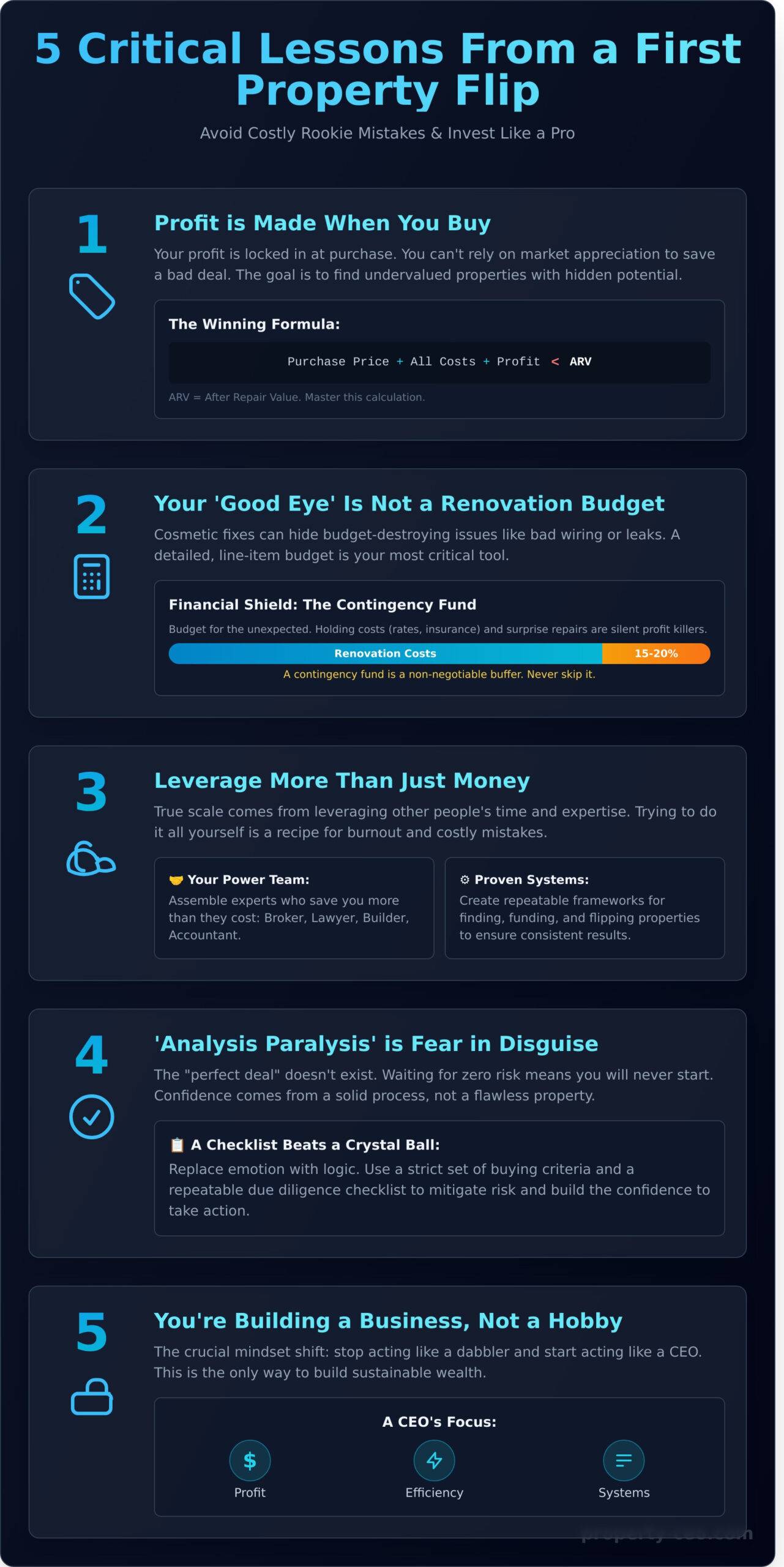
Lesson 1: Profit Is Made When You Buy, Not When You Sell
My first mistake was a classic rookie error: I got caught up in the excitement and overpaid for a property. I told myself that the rising NZ property market would bail me out, that a quick renovation would magically create a massive profit margin. I was wrong. The hard truth is that you can’t rely on market appreciation to save a bad deal. The real strategy, the one that separates professional investors from hopeful amateurs, is finding undervalued properties with hidden potential and buying them at the right price.
This means you must focus on the cold, hard numbers before you ever get emotionally attached to the potential of a property. Your profit is locked in the moment you sign the purchase agreement, not six months later when you put it back on the market.
Why ‘Hunting for Deals’ is a Full-Time Mindset
To find these opportunities, you need a system to consistently find off-market or undervalued deals. If you’re only scrolling through public listings on Trade Me or OneRoof, you’re playing the same game as every other retail buyer and competing for overpriced, picked-over stock. You have to learn to see what other buyers miss-the potential in a poorly marketed property, a house with a “weird” layout, or a deceased estate that needs a quick sale. This isn’t a passive hobby; it’s an active hunt.
The Numbers That Actually Matter in a Deal Analysis
Your analysis must go far beyond the purchase price. You need to meticulously factor in every potential cost: renovation estimates, professional fees, holding costs (like rates and insurance), and selling costs (agent commissions and marketing). The most critical number is the ARV (After Repair Value), and you must learn how to calculate it accurately by looking at comparable sales, not just listings. Your purchase price must leave enough room to cover all these costs, absorb any surprises, and still deliver a healthy profit.
Lesson 2: Your ‘Good Eye’ Is Not a Renovation Budget
I walked into my first property and thought I had a great handle on the costs. “A bit of paint here, new carpet there, maybe update the kitchen…” I was wrong. Dangerously wrong. My “good eye” couldn’t see the outdated wiring hiding in the walls or the slow leak under the bathroom floor. Cosmetic updates can easily hide major structural and compliance issues that will destroy your budget and timeline.
Your most critical tool isn’t a colour swatch; it’s a detailed, line-item budget created with input from professionals. Every single anticipated expense needs to be on that spreadsheet before you commit to the purchase.
The Hidden Costs That Wreck First-Time Flippers
It’s the costs you don’t see that hurt the most. Holding costs are a silent killer; every month you own the property, you’re paying rates, insurance, and interest on your loan, all of which eat directly into your profit. This is why you must have a contingency fund-a buffer of at least 15-20% of your renovation budget that you absolutely cannot skip. And don’t forget the professional fees for your lawyer, accountant, and any council consents, which can quickly add up.
Building a Realistic Renovation Scope
The goal is not to build your personal dream home; it’s to create a product that appeals to the widest range of buyers in that specific market and adds the most value. Get multiple, detailed quotes from trusted tradespeople before you go unconditional on the property. Be ruthless about avoiding over-capitalization. A high-end European stove might look great, but if it doesn’t increase the final sale price by more than its cost, it’s a bad business decision.
Lesson 3: Leverage Is More Than Just the Bank’s Money
When I started, I thought “leverage” just meant getting a mortgage from the bank. That was only one small piece of the puzzle. I quickly learned that trying to do everything myself-from project management to negotiating with suppliers-was the fastest way to burn out and make costly mistakes. True scale and success in property come from leveraging other people’s time, money, and expertise. Building a team isn’t a luxury; it’s a necessity.
Leveraging Your ‘Power Team’
Your “Power Team” is your greatest asset. This includes a sharp mortgage broker who understands investor finance, a meticulous lawyer, a savvy accountant, and a reliable builder or project manager. It might feel like an extra cost upfront, but these professionals will save you far more money than they charge by helping you avoid pitfalls, structure deals correctly, and execute projects efficiently. Don’t try to be an expert in everything; leverage their decades of combined knowledge.
Leveraging Systems and a Community
The most powerful form of leverage is a proven system. A repeatable framework for finding, funding, and flipping properties removes the guesswork and allows you to repeat your successes consistently. It’s the difference between having a lucky one-off win and building a real, cash-generating business. Equally important is a community of fellow investors who can hold you accountable, share their own lessons, and keep you motivated when challenges arise. You don’t have to figure this all out alone. You can See the proven system our members use to flip properties successfully and build wealth without quitting their jobs.
Lesson 4: ‘Analysis Paralysis’ Is Just Fear in Disguise
I spent a full six months searching for the “perfect” deal. I analysed hundreds of properties, built dozens of spreadsheets, and passed on several good opportunities because they weren’t flawless. The hard truth? The perfect deal doesn’t exist. Waiting for a scenario with zero risk means you will never, ever take action. Confidence doesn’t come from finding a perfect property in a perfect market; it comes from having a solid, repeatable due diligence process that mitigates risk.
How to Overcome the Fear of Starting
The best way to break through the fear is to narrow your focus. Choose one specific strategy (e.g., cosmetic flips) and one specific market you can get to know inside and out. Then, set a non-negotiable deadline to make your first offer, even if it’s a low one. Understand that your first deal is as much about education as it is about profit. The real-world experience you gain will be invaluable for every deal that follows.
A Checklist Is Better Than a Crystal Ball
You can’t predict the future, but you can control your process. Develop a strict set of buying criteria and a repeatable due diligence checklist, and stick to them religiously. This systematic approach turns an emotional decision into a logical one. A good system doesn’t just find great deals; it helps you make an “okay” deal profitable by ensuring you’ve accounted for all the variables and have a clear plan of attack.
Lesson 5: You’re Not Just Buying a House, You’re Building a Business
The biggest and most crucial mindset shift happened when I stopped thinking of myself as a hobbyist dabbling in property and started acting like a CEO. When you treat your investing like a business, it forces you to focus on what truly matters: profit, efficiency, and systems. This is the only way to truly stop trading your time for money and start building real, lasting wealth. You become the strategist, not just the labourer.
From One-Off Flip to a Scalable Portfolio
As you complete your first flip, document every step, every contact, and every lesson learned. This becomes your personal playbook for the next deal. Before the first property is even sold, you should be thinking about how you will fund the second one. The goal is not to create a stressful, all-consuming second job for yourself; it’s to build a cash-generating machine that can operate systematically and grow over time.
Adopting the CEO Mindset
As the Property CEO, you are the strategist, not the painter, the project manager, or the cleaner. Your highest-value tasks are finding good deals, raising capital, and managing your expert team. Delegating the rest is not laziness; it’s smart business. This focus on high-level activities is the absolute key to scaling your efforts and creating the financial freedom you’re looking for.
Frequently Asked Questions
How much money do I really need for my first investment property flip in NZ?
While the exact amount varies, you’ll generally need a deposit (typically 20-40% for investment properties), plus funds to cover the renovation, holding costs, and a contingency buffer. Many successful investors start by using equity from their own home or partnering with others to fund their first deal.
Is property flipping still a good strategy in the current New Zealand market?
Yes. While the market changes, the core principles of a good flip remain the same: buy an undervalued property, add value through smart renovations, and sell for a profit. In any market-up, down, or flat-there are always opportunities for investors who have a solid system for finding and creating value.
Do I need a builder’s license or trade skills to flip a house?
Absolutely not. In fact, some of the most successful investors have no trade skills at all. Their skill is in finding the deal, managing the project, and controlling the numbers. It’s more important to be a good businessperson and project manager than a good builder.
How long does a typical property flip take from purchase to sale?
A typical cosmetic flip can take anywhere from 3 to 6 months. This includes the purchase settlement period, the renovation phase, and the time it takes to market and sell the property. More complex projects with structural changes or council consents can take longer.
What’s the biggest mistake first-time property investors make?
The biggest mistake is insufficient due diligence and underestimating costs. This usually stems from getting emotionally involved in a deal and failing to run the numbers properly, leading to a small profit margin or even a loss.
Learning from these lessons can save you years of trial and error. You don’t have to make the same mistakes I did. By adopting a business mindset, focusing on systems, and leveraging the expertise of others, you can turn property into a predictable path to financial independence. The opportunity is there for everyday Kiwis who are ready to stop trading time for money. The only question is, are you ready to take action? Stop waiting. See how you can execute your first profitable flip.