

As a property investor, you’re not just buying houses-you’re the CEO of your own property business. And like any successful CEO, you need to have a firm grip on your numbers. One of the most critical numbers to master in New Zealand is the Goods and Services Tax (GST). Getting it wrong can eat into your profits and create major headaches, but getting it right puts you in complete control of your budget and cash flow.
Forget the confusing jargon and complex tax guides. This is a straightforward, no-nonsense guide to help you master the simple formulas for calculating GST on your property deals, so you can manage your costs and profits like a true Property CEO.
What is GST and Why Does it Matter for Property CEOs?
At its core, GST is a 15% tax applied to most goods and services sold in New Zealand. For property investors and flippers, its impact is everywhere-from the materials you buy at a hardware store to the invoice from your real estate agent. Understanding GST isn’t just an accounting task; it’s a fundamental part of managing your project budget and protecting your hard-earned profit.
Think of it this way: GST is not just another expense to be paid. For a savvy investor, it’s a critical component of your business’s cash flow. Knowing how to calculate it accurately means you can budget precisely, read quotes with confidence, and make smarter financial decisions at every stage of your property flip.
GST-Inclusive vs. GST-Exclusive: A Crucial Distinction
Before diving into calculations, you must understand the difference between two key terms: GST-inclusive and GST-exclusive. This distinction can save you thousands of dollars and prevent misunderstandings with contractors.
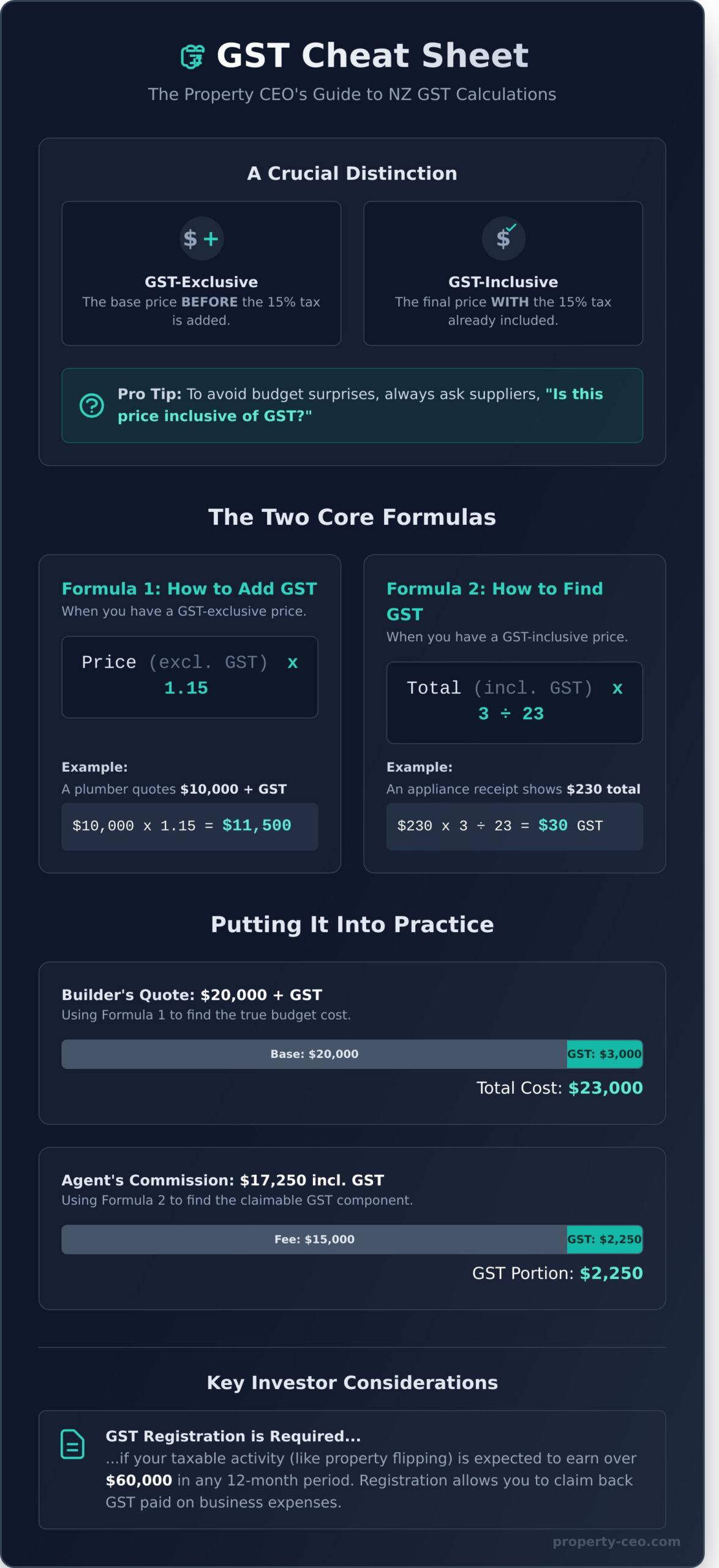
- GST-exclusive: This is the base price of a product or service before the 15% tax is added.
- GST-inclusive: This is the final price you actually pay, with the 15% tax already included.
A common pitfall for new investors is assuming a quoted price is the final price. To avoid nasty surprises, always ask your contractors and suppliers one simple, powerful question: “Is this price inclusive of GST?” Getting this confirmation in writing will ensure your budget remains accurate.
The Core Formulas: Calculating GST Made Simple
You don’t need to be an accountant to handle GST calculations. In fact, you only need two simple formulas to manage almost any situation you’ll encounter, whether you’re adding GST to a price or figuring out how much GST is already included in a total.
Formula 1: How to Add GST to a Price
Use this formula when you receive a GST-exclusive price, like a quote from a builder or electrician. This tells you what the final bill will be.
- The formula: Price (excl. GST) x 1.15 = Total Price (incl. GST).
- Example: Your plumber quotes you $10,000 (excl. GST) for a bathroom renovation. The calculation is $10,000 x 1.15 = $11,500. This is the final amount you need to budget for.
Formula 2: How to Find the GST Within a Price
Use this formula when you have a final, GST-inclusive price, like a receipt from a store, and you want to know how much of that total was GST.
- The formula: Total Price (incl. GST) x 3 ÷ 23 = GST Amount.
- Example: You buy a new appliance for $230 (incl. GST). The calculation is $230 x 3 ÷ 23 = $30. This means $30 of the price was GST.
- To find the original exclusive price, simply subtract the GST amount from the total price ($230 – $30 = $200).
Putting it into Practice: GST Calculations for Your Flip
Theory is one thing, but as a Property CEO, you care about real-world application. Let’s apply these simple formulas to common scenarios you’ll face during a property flip to see how GST impacts your numbers on a typical project.
Example 1: Your Builder’s Quote for a Renovation
A builder gives you a written quote for a new kitchen that says “$20,000 + GST.” You immediately know this is a GST-exclusive price. To find the true cost for your budget, you use Formula 1.
- Calculation: $20,000 x 1.15 = $23,000.
- The takeaway: Your actual cost for the kitchen renovation is $23,000. Budgeting the lower amount would have left you $3,000 short.
Example 2: Real Estate Agent’s Commission
After a successful sale, your real estate agent’s commission invoice is for $17,250, including GST. To understand the breakdown, you use Formula 2 to find the GST component.
- Calculation: $17,250 x 3 ÷ 23 = $2,250 GST.
- The takeaway: The agent’s pre-tax fee was $15,000, with $2,250 added as GST. This is crucial information if you are GST-registered and can claim this amount back.
Key GST Considerations for NZ Property Investors
Calculating GST is the first step; strategically managing it is the next. While you should always seek professional advice from a qualified accountant for your specific situation, there are key concepts every Property CEO must understand to navigate the landscape effectively.
GST Registration: When is it Required?
In New Zealand, you are required to register for GST if your “taxable activity” (like flipping houses for profit) is expected to earn more than $60,000 in any 12-month period. For most serious property flippers, this is a key threshold. The major advantage of being registered is that you can claim back the GST you pay on your business-related expenses, such as renovation materials and contractor fees.
Zero-Rating on Property Transactions
You may hear the term “zero-rated” in relation to property sales. This is a complex area where a transaction between two GST-registered parties can sometimes have GST applied at a rate of 0%. This is highly specific and depends on the nature of the property and the parties involved. It is essential to get professional accounting advice before entering into any such agreement.
Stop Calculating, Start Strategizing
Understanding the numbers is vital, but your most valuable time as an investor is spent finding great deals and executing your strategy. A proven, step-by-step system for flipping property is what separates amateurs from empowered Property CEOs. Instead of getting bogged down in spreadsheets, you should be focused on the high-value actions that build your wealth. Let us show you the blueprint to replace your salary with one property flip.
Frequently Asked Questions
- What is the current GST rate in New Zealand?
- The current GST rate in New Zealand is 15%.
- Do I have to pay GST on residential rent?
- No, residential rent is considered an “exempt supply,” which means it is not subject to GST.
- Is GST included in the sale price of a house?
- It depends. For most private sales of residential homes, GST is not a factor. However, if the seller is a GST-registered entity (like a developer or professional flipper), GST may be included. Always clarify this in the sale and purchase agreement.
- Can I claim GST on my investment property purchase?
- If you are GST-registered and purchase a property for your taxable activity (e.g., to flip), you may be able to claim the GST portion. This is a complex area and you must get advice from an accountant.
- How do I file a GST return with the IRD?
- GST returns are typically filed online through the Inland Revenue (IRD) myIR portal. You will report the total GST collected on sales and the total GST paid on purchases, and then pay or receive the difference.
Disclaimer: This article is for informational purposes only and does not constitute financial or tax advice. The rules around GST and property can be complex. Always consult with a qualified accountant for advice tailored to your specific situation.
Knowing how to calculate GST is a skill that puts you firmly in the driver’s seat of your property business. But it’s just one piece of the puzzle. If you’re ready to move beyond the basics and build a real property empire, you need a proven system and a community of experts behind you. Our members have completed over $100M in property deals because they have a step-by-step plan, not just theory. Request a Free Strategy Call today and find out how you can become the next Property CEO.